
Sources: EPA, A Brief Guide to Mold, Moisture and Your Home (updated February 18, 2026). The rest is how we work on commercial flat roofs in Palm Beach County.
How to repair a roof leak on a flat or low-slope roof comes down to three jobs, in this order: protect the inside of the building, find where the water actually gets in, and repair that defect so it stays repaired. The second job is the one that usually goes wrong. Water inside a flat roof travels along the deck and insulation before it drips, so the stain on the ceiling is rarely under the hole.
This guide is for owners and managers of commercial buildings, plazas, churches and HOA buildings: what you can safely do today, how a proper leak search works, and what a permanent repair looks like. If water is coming in right now, our commercial roof leak repair page has the number to call. Active leaks get moved up the list.
In this guide
- Step 1: Protect the inside of the building
- Step 2: Read the clues from below
- Step 3: Find the real entry point
- Temporary roof leak fixes and their limits
- Step 4: How to repair a roof leak so it stays repaired
- When to stop repairing leaks
- When to call for roof leak repair in Palm Beach County
- Roof leak repair questions
Step 1: Protect the inside of the building
Start below the roof, not on it. Nothing done on the roof in the next hour will matter as much as keeping water off the floor, the electrics and the stock.
- Catch the water. Buckets under each drip. A small hole at the low point of a sagging, full ceiling tile lets it drain instead of dropping in one piece.
- Move what matters. Stock, files and computers. Cover what cannot be moved with plastic sheeting.
- Keep water away from power. If water is near light fittings, panels or outlets, keep people clear and get an electrician to check before that circuit is used.
- Start drying. The EPA says water-damaged areas and items should be dried within 24 to 48 hours to prevent mold growth. It also notes that porous materials such as ceiling tiles and carpet may have to be thrown away once they are moldy.
- Take photos. The stain, the drip points and any damage, with the date. They help whoever searches for the leak.
Step 2: Read the clues from below
Before anyone goes on the roof, the inside of the building tells you a lot. Write these down. They narrow the search.
| What you notice | What it usually points to |
|---|---|
| Leaks only in wind-driven rain | A vertical or edge detail: parapet counter-flashing, wall junctions, terminations, the upwind side of a curb |
| Leaks in any heavy downpour | A horizontal defect: an open seam, a split in the membrane, a failed patch, a drain or a penetration |
| Leaks hours after the rain stops | Water held in the roof assembly, often wet insulation, draining slowly through the nearest gap |
| The leak moves from room to room | Water traveling along the deck. Often the same defect, not a new one |
| Drips near a rooftop unit or duct | The unit’s curb flashing, or condensate, which is a mechanical problem and not a roof leak at all |
Check that last row before you pay anyone. A blocked condensate line can drip like a roof leak, even on dry days. If it drips when it has not rained, call the HVAC contractor first.
Step 3: Find the real entry point
On a flat roof, the water does not fall straight down. It gets in at a defect, runs along the deck or the top of the insulation, follows joints and structural members, and comes through the ceiling wherever it finds a way. That can be a long way from where it entered. Patching the roof directly above the stain often seals a piece of sound roof while the real defect keeps working.
A proper search works uphill from the interior evidence and checks the places leaks actually start, in order of likelihood:
- Penetrations and curbs. HVAC curbs, exhaust fans, pipe boots and equipment supports. Every hole through the roof is a joint that moves.
- Drains and scuppers. The roof around a drain sees the most water, and debris holds it against the seal.
- Edges and terminations. Parapet walls, counter-flashings, metal edge and the junction where the roof turns up a wall.
- Seams. Lap seams on single-ply and modified bitumen roofs open with heat and movement, especially on older roofs.
- Previous repairs. An old patch marks where the roof has been failing, or is the leak itself.
- The open field. Punctures, splits and blisters. On the buildings we are called to, the answer is at a detail far more often than here.
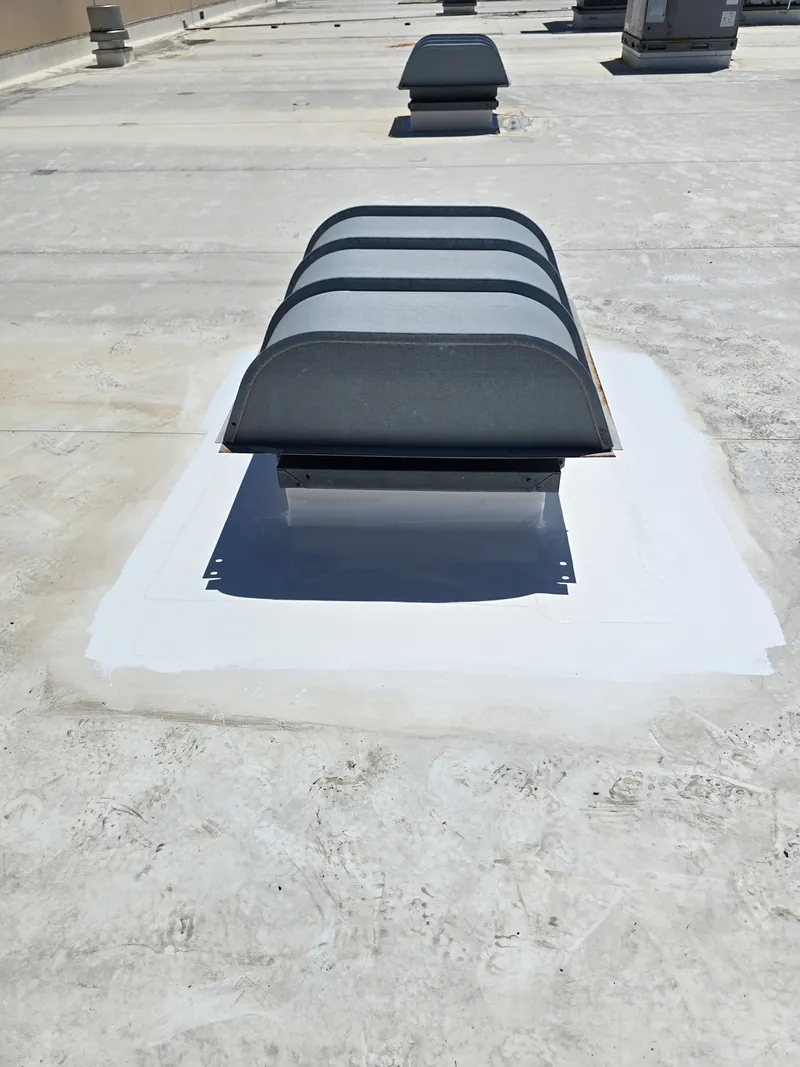
Is it safe to look yourself? Only from somewhere you can stand securely, such as a roof with a parapet and a fixed hatch, in dry weather. OSHA’s fall prevention campaign notes that falls are the leading cause of death in construction, and that anyone six feet or more above a lower level is at risk of serious injury or death.
Wet membranes are slippery and skylights are not walkable. A photo is useful. Walking an unguarded edge in the rain is not.
Temporary roof leak fixes and their limits
A temporary fix buys time until the roof is dry enough for a proper repair. It is not the repair.
- Clearing drains and scuppers. The most useful thing you can do on many flat roofs. If debris is holding water over a weak spot, clearing it can stop the leak for now. It does not fix the weak spot.
- Roof cement or sealant over a visible split. It can slow water down. On a joint that moves with heat, sealant alone cracks and lets go, usually on schedule with the next hot spell.
- Tarps. Common on sloped roofs, much less useful on flat ones. Water runs under a tarp on a low slope, and the weights or fasteners holding it can damage the membrane.
Whatever you put on, tell the person doing the repair. Some sealants have to come off before the repair products will bond.
Step 4: How to repair a roof leak so it stays repaired
A lasting repair on a commercial flat roof follows the same sequence whatever the membrane. This is how we carry out roof leak repair on TPO, EPDM, modified bitumen, built-up and metal roofs.
- Confirm the cause. The search in step 3 ends with one defect that explains the interior evidence. If it does not explain it, the search is not finished.
- Prepare the area. Clean back to sound, dry material. Loose patching, failed sealant and dirt come off. Nothing bonds well to a dirty roof.
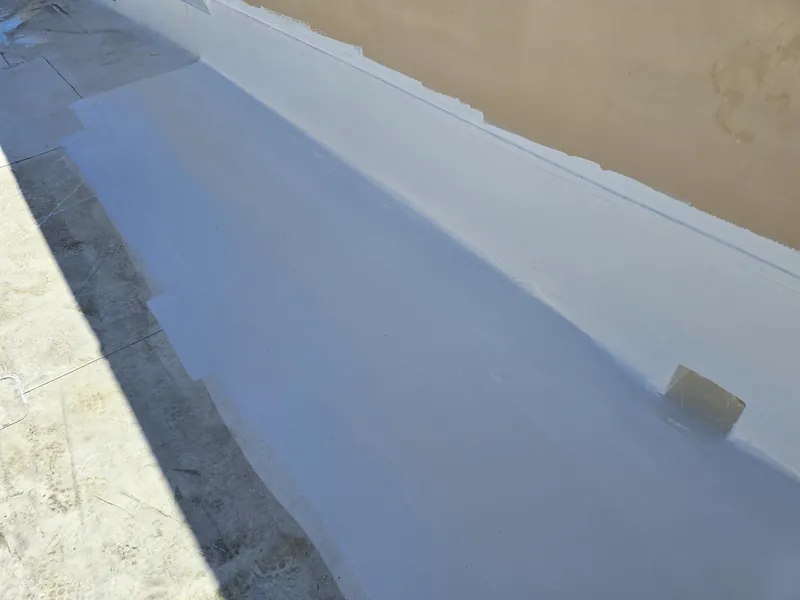
- Repair and reinforce. The defect is closed and re-detailed with reinforcing fabric embedded in the repair material, rather than smeared with sealant. Fabric lets the repair move with the roof instead of cracking.
- Detail the whole joint. A curb is repaired all the way around, not just on the side that leaked. A seam is repaired along its failed length, not at one spot.
- Check the neighbors. Other details heading the same way are cheaper to fix now than after the next storm.
Is the roof still under a manufacturer’s warranty? Say so before anyone touches it. Depending on the manufacturer and the system, a repair by someone else can affect the warranty. Where a warranty is live, the right route is often work carried out to preserve it.
When to stop repairing leaks
One leak at a curb is a repair. A new leak every few months, in different places, usually means the roof is near the end of its service life. At that point each repair postpones a decision rather than solving anything. These signs point past patching:
- Leaks from several different areas within a year
- Seams opening across the roof, not at one spot
- Soft or spongy areas underfoot, which point to wet insulation
- Water that keeps dripping for hours after the rain stops
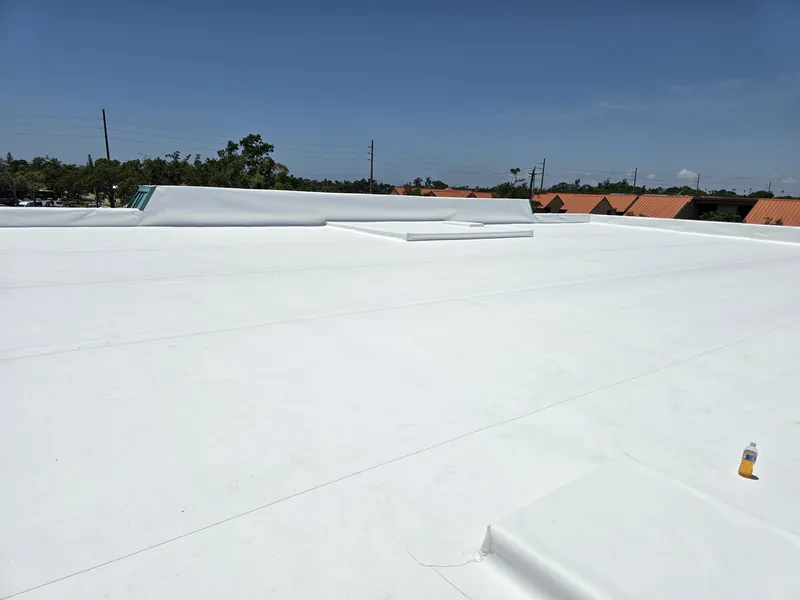
That is not automatically a tear-off. If the insulation is dry, roof restoration with a coating system can renew the whole surface over the existing roof. If the insulation is saturated, a coating would seal the water in, and replacement is the honest answer.
When to call for roof leak repair in Palm Beach County
Call as soon as water is coming in, before the next rain, and before anyone patches the spot above the stain. We are based on South Congress Avenue in Palm Springs, so most of the county is a short drive. We work on commercial flat and low-slope roofs in West Palm Beach, Palm Springs, Lake Worth Beach, Jupiter, Boca Raton and the rest of our service area, including leaks on roofs we did not install.
Our commercial roof leak repair starts with a free evaluation. We find the actual entry point, repair the cause, and tell you what else we found up there while it is still cheap to fix.
Roof leak repair questions
How do you repair a roof leak on a flat roof?
Protect the inside first, then find where the water actually enters, which is usually at a penetration, curb, drain, seam or edge uphill of the stain. The lasting repair cleans the area back to sound material, closes the defect and re-details it with reinforcing fabric rather than sealant alone, then checks nearby details heading the same way.
Can you repair a roof leak from the inside?
Not permanently. From inside you can catch the water, dry the building and replace damaged ceiling tiles, but the defect is on the outside of the roof. Sealing the underside of the deck can trap water in the roof assembly and soak the insulation.
How fast do I need to deal with water from a roof leak?
The EPA says water-damaged areas and items should be dried within 24 to 48 hours to prevent mold growth. Porous materials such as ceiling tiles and carpet may have to be thrown away once they are moldy, so drying out the building comes before anything else.
Will a roof leak repair void my roof warranty?
It can, depending on the manufacturer and the system. Tell whoever repairs the roof that it is still under warranty before anyone touches it. Where a manufacturer warranty is live, the right route is often a repair carried out to preserve it.